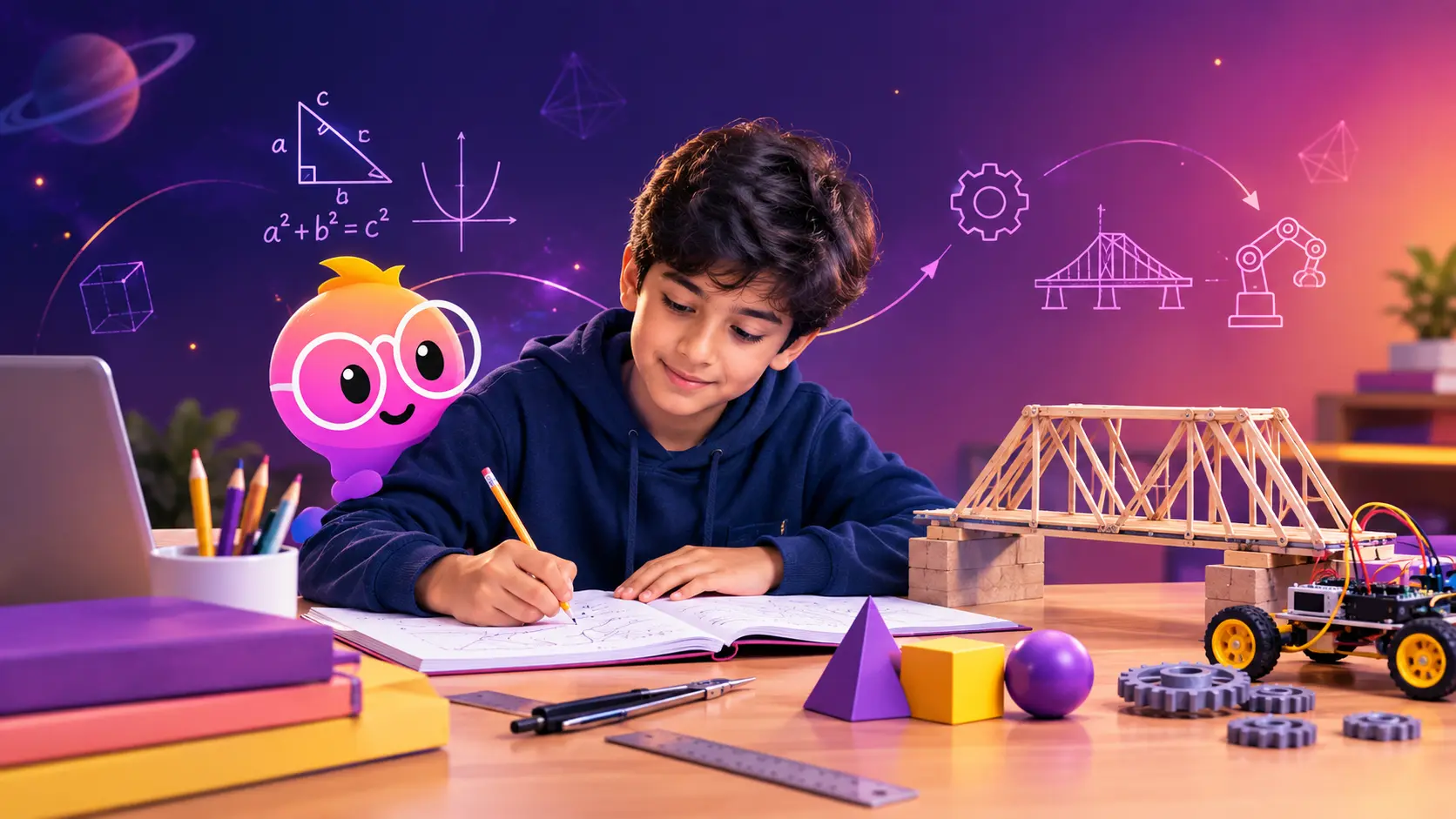
Can Math Help Students Become Better Engineers?
The Connection Parents Often Underestimate
When parents think about preparing a child for a future in engineering, mathematics competitions aren't always the first thing that comes to mind, yet the connection is far stronger than most people realise. QuestX Quiz has seen this pattern play out repeatedly among students in the UK, USA, Canada, Ireland, New Zealand, and Australia who go on to pursue engineering pathways after years of engaging with competitive mathematics.
This article explores exactly how strong mathematical foundations, particularly the kind built through competition-style problem-solving, translate into genuine engineering readiness.
Engineering Is Fundamentally Applied Problem-Solving
Engineering is basically using maths and science to deal with problems in the real world. Those problems are often not neat. People learn this kind of thinking early in competition maths. You split big tasks into smaller ones. You look over your steps to make sure they are right. You also keep going when it gets hard. Those same habits show up a lot when engineers do their day to day work.
Spatial Reasoning and Geometry
A lot of engineering work needs spatial thinking. This shows up in structural design, mechanical parts, and electrical layouts. Students who pick up strong geometric sense early often do better. They learn this through maths, with time spent on shapes, sizes, and how things line up in space. That practice can put new engineering students ahead from the start.
Algebraic Fluency for Modelling Real Systems
Engineers often make maths models for things in the real world. They write equations that link variables. Those variables might be force, voltage, or how fast fluid moves.
In class, some students get to know algebra in a real way. They do not just follow steps they have seen before. When a student has that solid skill, later modeling tasks feel less confusing.
Logical Reasoning and Systematic Debugging
Whether debugging a circuit, a piece of code, or a structural calculation, engineers rely constantly on systematic logical reasoning to isolate where something has gone wrong. This is precisely the same skill developed through the process of reviewing mistakes in competition mathematics, tracing back through a solution to find exactly where reasoning broke down.
Comfort With Uncertainty and Estimation
Real engineering problems rarely come with neat, exact answers the way textbook problems do. Engineers frequently need to estimate, approximate, and work within tolerances. Competition mathematics, which regularly demands estimation and sanity-checking of answers, builds genuine comfort with this kind of approximate reasoning.
Persistence Through Complex, Multi-Step Problems
Engineering projects, much like advanced competition mathematics problems, rarely resolve in a single step. People who have trained their focus for long problem chains, usually from years of contest work, often deal with the longer and more layered parts of real engineering tasks without getting as stuck or annoyed.
When students are asked to wrestle with problems that need more than one study session, not just quick drills they can finish in one sitting, they start to stick with hard work the way real engineering problems require.
Early Exposure Shapes Later Subject Choices
Students who develop genuine confidence and enjoyment in mathematics during their school years are considerably more likely to elect physics, computer science, and advanced maths courses in secondary school, courses that directly feed into engineering degree eligibility at university level.
Building the Foundation Early Matters More Than People Realise
You cannot just rush engineering readiness into one year right before university applications. The basics like handling abstract ideas, working with space in your head, and solving problems in an orderly way build slowly. That is why it helps to start meeting hard math early and keep doing it, not only at the last moment.
Conclusion
The connection between strong early mathematics engagement and later engineering success is genuine and well worth taking seriously for parents thinking ahead about their child's academic trajectory. Families across the UK, USA, Canada, Ireland, New Zealand, and Australia interested in engineering pathways should recognise the real value of building these foundations early.
QuestX Quiz runs gamified maths challenges and quests for students in Grades 3 through 10 across all six countries, helping build exactly the kind of problem-solving stamina and spatial reasoning that future engineers rely on. Parents interested in guiding their child toward this pathway can reach out to the team for further assistance.
Frequently Asked Questions
Does a child need to be exceptionally gifted at maths to become a good engineer?
No, consistent engagement and strong foundational skills matter more than exceptional natural talent, since engineering rewards persistence and systematic thinking as much as raw ability.
Which area of mathematics matters most for future engineers?
Algebra, geometry, and logical problem-solving all matter significantly, though the specific emphasis can vary depending on which engineering discipline a student eventually pursues.
Can competition mathematics specifically help with engineering readiness?
Yes, the problem-solving habits, persistence, and comfort with multi-step reasoning built through competition mathematics translate directly into skills engineering coursework demands.
At what age should a child start building these foundational skills?
Earlier is generally better, since spatial reasoning, algebraic thinking, and problem-solving stamina all develop cumulatively over many years of consistent engagement.