Why Is Math So Difficult? Common Problems and Solutions
Why is math so difficult for so many students? Part of it is that maths has a bit of a PR problem. Ask a group of grown-ups at a barbecue which subject they found hardest at school and you'll get a chorus of "maths!" before anyone's finished their burger. Ask a class of Year 8s and it's the same. Even kids who are perfectly good at it will often tell you it's the lesson that makes their stomach flip a little.
So what's really going on? Here's our honest take after years of watching children wrestle with it. It's not that you need some special maths brain. Most of the trouble comes from a handful of really predictable things, and the reassuring part is that every one of them can be fixed with fairly ordinary effort. Let's go through them one at a time.
Common Math Problems and Solutions
Problem 1: it's built like a tower
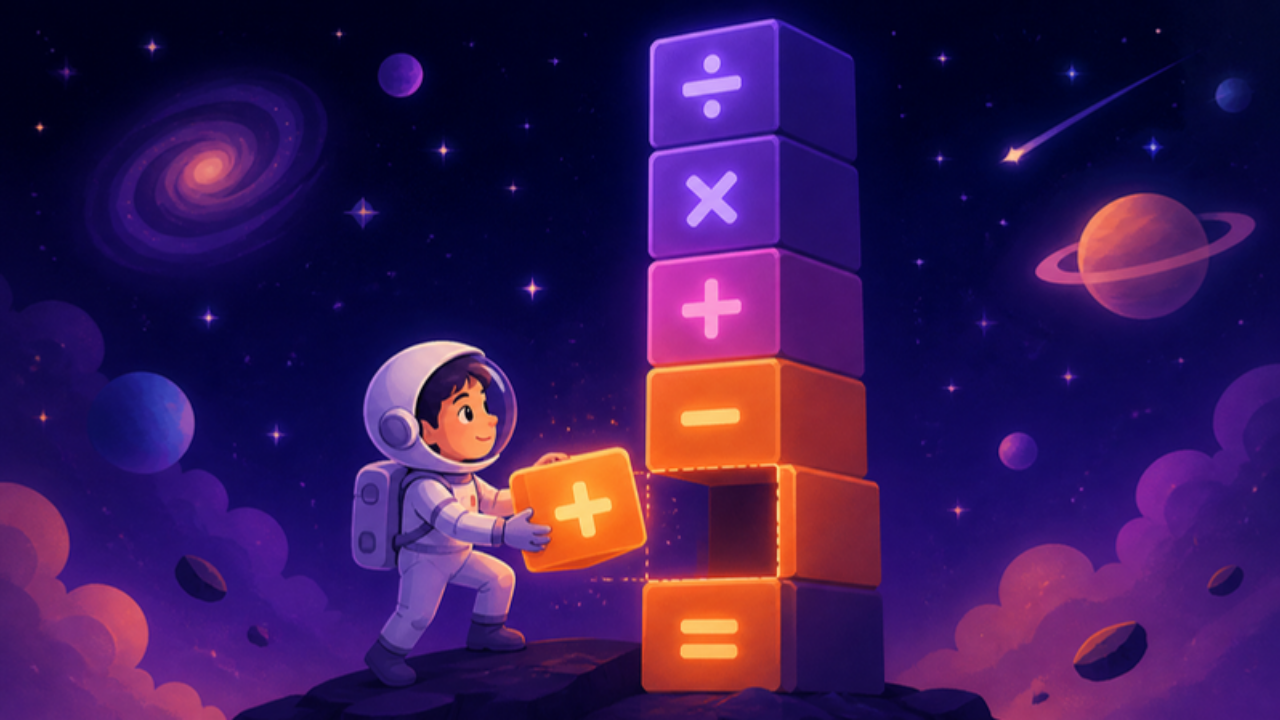
In plenty of subjects you can miss a topic and be fine with the next one. Skip the Romans in history and you can still follow the Tudors. Maths is meaner than that. It's a tower of blocks, with times tables propping up division, division propping up fractions, and fractions holding up half of algebra. Knock one out in Year 4 and you mightn't notice for ages, until one day in Year 8 the whole thing sways and your child comes home announcing they "just don't get maths anymore". All they know is that maths "suddenly got hard" sometime around Christmas.
What helps
When a child's stuck on something, peek one or two floors down. A Year 9 who can't simplify algebraic fractions is very often shaky on plain old fractions. A Year 6 battling long division may just not have quick times tables yet.
Patching the floor below can feel like going backwards, and kids sometimes find it a bit insulting ("this is Year 5 stuff!"). But a couple of weeks on the missing piece often makes the current topic click almost overnight. Often the quickest way to find the gap is to sit next to them for one question and watch for the exact moment the pencil stops.
Problem 2: it's abstract
A lot of maths is about stuff you can't see or touch. Even the number 3 is a bit abstract if you think about it, since you can have three apples but you can never actually hold "three". Algebra takes it further and swaps the numbers for letters. Then come negatives, and irrational numbers, and functions, and proofs.
For lots of students, younger ones especially, this is the real wall. Ask them how many sweets each child gets when twelve are shared between four friends and they'll tell you straight away. Write 12 ÷ 4 on the board and there's a pause. Write 4x = 12 and you can practically hear the brain shutting down.
What helps
Good maths teaching moves from real objects to pictures and only then to symbols. Singapore maths, which lots of schools in the UK and US now use, is built on exactly that idea. So if a kid's stuck on the symbol version, take a step back. Bar models make fractions and ratio questions visible, and a number line makes negative numbers far less mysterious. For expanding brackets, a little rectangle split into four boxes suddenly makes it obvious. Once the picture makes sense, the symbols tend to follow.
Problem 3: learning tricks instead of ideas
When time's tight, it's very tempting to teach maths as a bag of tricks. "To divide fractions, flip the second one and times." "Move it to the other side and change the sign." These get kids through Friday's test, but they collapse the moment a question looks slightly different.
And tricks fall out of your head like keys out of a torn pocket. Learned on Thursday, used on Friday, gone by half-term, and then next September the teacher says "you all remember this from last year" and thirty faces go blank.
What helps
Every method has a reason behind it. Why does a negative times a negative give a positive? Why is a triangle's area half the base times the height? Spending five minutes on the why makes the how much easier to remember and adapt. Parents can help just by asking "why does that work?" during homework, and if nobody at the table knows, it's a cracking question to take into school the next day.
Problem 4: not enough practice, or the wrong sort
Maths is partly knowledge and partly a skill, a bit like playing the guitar. Kids who only do maths in lessons plus the odd worksheet often just don't get enough reps for things to become automatic.
On the flip side, some students practise loads but in a way that doesn't stick, twenty identical questions on one topic, then never look at it again. They feel brilliant that evening and remember none of it a month later.
What helps
Our rule of thumb is a bit every day, all jumbled up. So instead of twenty fraction sums back to back, do a handful of fractions, then some angles, then a couple of percentages, then whatever else is lying about. Kids grumble that it feels harder. Good, that's the bit that's working. Researchers like Doug Rohrer in the US have found that this kind of mixed-up practice leads to much better long-term results than practising one thing at a time. And a quick five-question warm-up on last month's topic at the start of each session stops things going rusty.
Problem 5: shaky number facts
Picture a kid working out 7 × 8 on their fingers halfway through a three-step problem. By the time they've got 56 they've forgotten what they needed it for. It's one of the most common reasons perfectly capable students find longer questions overwhelming.
What helps
Get the tables and bonds so quick they come out without thinking, same with doubling and halving and knowing a fifth is 0.2 is 20%. Five minutes a day is usually enough, through flashcards or an app or a silly game in the car. Of all the things a kid can do for their maths, this probably gives the best return for the least effort. For younger children, our second grade math practice guide covers these early number skills in more detail.
Problem 6: the fear factor
For some kids the hardest part of maths has nothing to do with the maths. It's the feeling. Maths anxiety is very real and very well studied. Sian Beilock, a psychologist who spent years researching it at the University of Chicago, showed that anxiety eats up working memory, which is exactly the bit of your brain you need to juggle the steps of a problem. So an anxious child can know the material inside out and still do badly, simply because worry's taking up all the room.
It usually starts small. Being put on the spot in front of the class and getting it wrong. A teacher or parent sighing at a mistake. Falling a bit behind and feeling embarrassed about it. Pile up enough of those and a kid starts expecting to fail, and that expectation is pretty good at making failure happen.
What helps
Take the pressure right off for a while. No timer, nobody peering over their shoulder, just questions they can actually do, creeping up in difficulty so slowly they barely notice. When they get stuck and keep going anyway, that's when you make the fuss. In tests, a few slow breaths before turning the paper over helps, as does starting with an easy question to get some momentum. There's also some lovely research by Gerardo Ramirez and Sian Beilock showing that kids who spend ten minutes writing down their worries just before a big test tend to do better. If the anxiety is really bad, talk to school, because most have pastoral staff who deal with exactly this.
Problem 7: not reading the question
You'd be amazed how many marks vanish before any maths has happened. Kids misread the question or answer a slightly different one. They miss a sneaky little word like "not" or "remaining", or forget the units. Word problems are the worst for it, since the maths is hiding inside a paragraph of English.
What helps
We get kids to read it twice with a pen in hand, underlining as they go, then circle whatever the question wants them to find. With word problems, a scrappy little drawing (stick people are fine) sorts out a surprising amount. And before writing the final answer, look back at the question and check you've actually answered it, not some other question you invented along the way.
Problem 8: "I'm just not a maths person"
This might be the most damaging sentence in education. Kids who believe maths ability is fixed tend to give up the moment a problem gets hard, because to them struggling proves they can't do it. Kids who believe it grows with effort tend to keep going, and so of course they improve.
A lot of this comes from home and from the world in general. When grown-ups cheerfully announce they were "never any good at maths", children hear that it's normal, maybe even a bit funny, to be bad at it.
What helps
Add one tiny word to "I can't do this", which is "yet". When you praise, praise the slog and the clever approach, never "you're just naturally good at it". Share stories of mistakes that led somewhere. And adults, even the ones who found maths miserable, can help by saying something like "I found this tricky too, let's work it out together" rather than "don't worry, I was rubbish at it as well".
Problem 9: the pace of lessons
Thirty kids, one teacher, one speed. Inevitably it's too quick for a few, who never quite finish digesting fractions before percentages turn up, and too slow for a few others, who spend the lesson flicking rubber bands. Both groups end up saying maths is hard, just for opposite reasons.
What helps
The kids who need longer usually do well revisiting things at home, or hearing someone on YouTube explain it in a different accent, as it were, or getting a bit of small-group help. The bored ones perk right up with harder extension work, puzzle books, a club, a competition to aim at. Either way, things improve as soon as someone notices where the child actually is and adjusts.
Problem 10: "when will I ever use this?"
Every maths teacher on the planet has heard it. Kids who can't see the point find it much harder to stay motivated, and motivation makes a massive difference to how much sticks.
What helps
Bits of it are obviously handy, like figuring out whether that "buy one get one half price" offer is any good. Other bits are the key to whole careers (engineers, doctors, game designers, people who build bridges that don't fall down), and it helps kids a lot to hear that.
But maths is also worth doing just because it can be fun. Lots of children only discover they like maths when they meet it as a puzzle rather than a worksheet, which is one reason competitions can help struggling kids as well as strong ones. QuestX Quiz, our online competition for Years 3 to 10, turns questions into missions in a space adventure, and it's genuinely lovely watching a kid who "hates maths" get hooked on finding out what happens next. We've written more about what happens when K–8 students engage with mathematics if you're curious.
So where do you start?
If your child finds maths hard, it's worth working out which of these is going on, and quite often it's a few at once. A gap from Year 4 can easily lead to anxiety and "I'm not a maths person" thinking further down the line. Filling the gap helps, but so does rebuilding their confidence alongside it.
In QuestX Quiz, A sensible plan usually looks something like finding the real gaps first, however far back that means going, then rebuilding them with pictures and real objects. Add a short daily practice habit with mixed topics, get the number facts automatic, keep asking why methods work, and sprinkle in puzzles or a competition to remind everyone maths can actually be fun.
Maths is hard, and that's fine
Let's be honest, maths is difficult. Professional mathematicians spend most of their working lives stuck on problems they can't solve yet. Finding it hard doesn't mean something's wrong, it's just what learning a subject that makes you think carefully feels like.
What really matters is how kids respond to that difficulty. With solid foundations, some patient support and a belief that effort actually pays off, nearly every child can get better at maths, and plenty of them will end up enjoying it too.